Hands That Held the Fleet Together: The Women Who Worked in Britain's Naval Dockyards
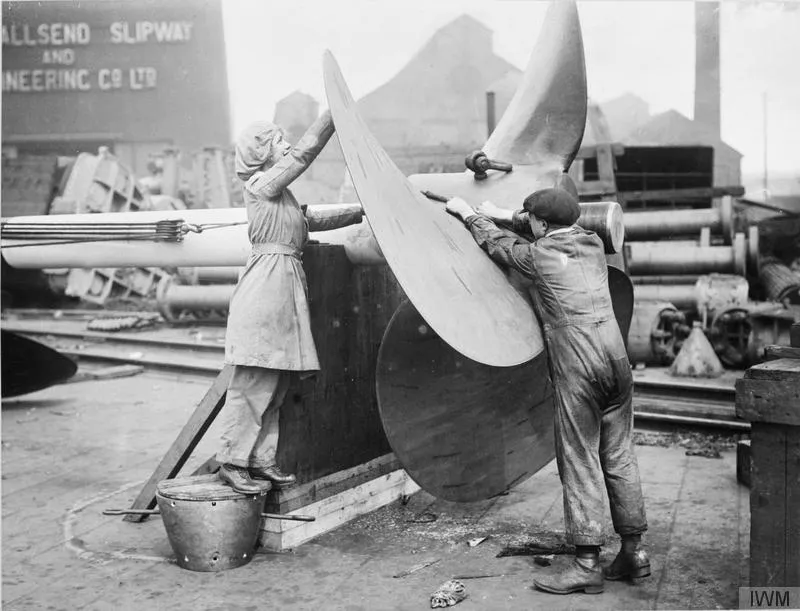
Photo: Unknown authorUnknown author, Public domain, via Wikimedia Commons
The Grand Fleet is usually imagined as a thing of steel and coal, of grey hulls at anchor and signals fluttering in an Orkney wind. It was also, in a sense that official histories rarely dwell upon, a thing made of labour — and by 1917 a growing part of that labour was female. In the royal dockyards at Portsmouth, Devonport and Chatham, and in the great private yards of the Clyde, the Tyne, the Mersey and Belfast, women entered workshops that had been closed to them for generations.
The Gates Open
The process was gradual and contested. Before 1914, women worked in naval establishments in limited numbers — in clothing factories, in canteens, in the more routine finishing trades — but the fitters, riveters, welders and shipwrights were men, and the trade unions meant to keep them so. The emergency of war broke the logic of that arrangement. Men were needed at sea and in the army; the fleet required repairs; the yards could not meet the demand with the labour that remained.
Beginning in 1915, and accelerating sharply through 1916 and 1917, the Admiralty sanctioned the employment of women in an expanding range of dockyard work. Agreements on dilution, negotiated with the unions under government pressure, allowed women to take on tasks previously reserved to skilled men, on the understanding — carefully written into the arrangements — that the positions would be restored to men after the war. That understanding shaped everything that followed.
What the Women Did
The popular image of the woman war worker is the munitions filler, handling cordite in a factory. In the dockyards the work was different: dirtier, heavier and closer to the ship itself. Women drove cranes and capstans; they operated drilling and milling machines; they cut and shaped plate with oxy-acetylene torches; they welded; they painted hulls and scraped and recoated the copper sheathing of bottoms exposed in dry dock; they made and repaired the countless fittings, pipes, valves and electrical components on which a modern warship depended.
Some tasks were more dangerous than the official record likes to admit. Rivet heating, in which a worker handled glowing metal at a forge and passed it to a riveter, exposed women to burns and to the relentless heat of a confined working space. Welding, still a relatively new trade, produced fumes and eye injuries with little protection. Heavy machinery in cramped and poorly lit shops caused accidents of the kind that the nineteenth-century yard had long accepted as normal. Women worked in these conditions in shifts, often at night, often in the cold.
Pay, Hours and Hazard
Wages were a grievance from the beginning. The standard practice across wartime industry was to pay women less than the men they replaced, even where the work was identical. Rates varied by yard and by trade, but women typically received something in the region of half to two-thirds of the male rate, and the differential was defended on grounds of custom and of the eventual restoration of male employment. Overtime, night work and the sheer physical strain of a fifty-four to sixty-hour week were endured for wages that seldom matched the responsibility of the task.
A further hazard was social. A woman in a yard was an anomaly to be inspected, doubted and frequently resented. Foremen trained under an all-male regime were not always sympathetic; some male workers, fearing for their own post-war positions, were openly hostile. Against this must be set the evidence, recorded in yard returns and in the memoirs of those who supervised them, that many women acquired genuine proficiency, and that a number stayed on in trades that had no female tradition whatsoever.
The Yard and the Ship
What did this mean for the fleet? In practical terms it meant that damaged ships returned to service sooner than they otherwise would have. The repair programmes that followed Jutland in the summer of 1916 placed enormous demands on the dockyards: armour plate to be replaced, compartments to be rebuilt, turrets and machinery to be restored. Docking schedules were compressed, shops ran continuously, and the workforce — increasingly female — was central to meeting them. The same was true of the unglamorous, ceaseless work of maintaining a fleet in being: refits, boiler cleaning, bottom scraping, and the thousand small rectifications that keep a ship at sea.
It is difficult to quantify the contribution precisely, and historians should be wary of overstating it. Women did not build the Grand Fleet; they helped to keep it serviceable. But in a war where readiness mattered more than any single engagement, serviceability was strategy.
After the Armistice
The end came quickly. Demobilisation, the collapse of wartime demand and the Restoration of Pre-War Practices Act of 1919 combined to remove women from the yards with remarkable speed. The agreements that had admitted them had always been temporary in intention, and they were enforced with little sentiment. By the early 1920s the dockyards were once again overwhelmingly male, and the skills that women had acquired in welding, machining and electrical work had no recognised place in the industrial order.
Some women found their way into the newer engineering trades; a few into offices and laboratories; the great majority returned to domestic work, to the textile and clothing trades, or left employment on marriage. The Women's Royal Naval Service, formed in 1917, had offered a different and more formal route into naval service, but its ratings were shore-based and administrative, and it too was disbanded after the war.
Memory and the 110-Year View
The dockyard women left few monuments. Their war is recorded in wage books, in dilution agreements, in the occasional photograph of a group in overalls and caps outside a workshop door. The 110th anniversary of the war's central years is a reasonable moment to look again at those records, and to recognise that the Grand Fleet's endurance at sea rested on a shore establishment in which women had become indispensable — and from which, once the emergency passed, they were quietly removed.