Under Fire from the Sea: Lowestoft, Yarmouth and the April Raid That Tested Britain's Coastal Defences
Photo: Chris Sampson, CC BY 2.0, via Wikimedia Commons
In the small hours of 25 April 1916 — Easter Tuesday — the war at sea arrived on the east coast of England without warning. The first shells fell on Lowestoft before four o'clock, tearing through terraces, chapels and the town's lighthouse, while holiday-makers' boarding houses still stood shuttered for the holiday weekend. An hour later, warships appeared briefly off Great Yarmouth and fired again. For two communities accustomed to reading about the Grand Fleet in the newspapers, the fleet had suddenly become a thing visible from the promenade.
A Squadron in the Darkness
The force responsible was Admiral Franz von Hipper's I Scouting Group, the battlecruiser squadron that would fight at Jutland six weeks later. It numbered five battlecruisers — Seydlitz, Derfflinger, Lützow, Moltke and Von der Tann — screened by light cruisers and torpedo boats, with U-boats and Zeppelins deployed in support. The plan was not merely to shell a town. It was to bring a portion of the British fleet out onto a chosen ground, where mines and submarines might do the work that German gunnery could not yet guarantee.
The operation was nearly undone before it began. Seydlitz struck a British mine while on passage and took on a substantial weight of water, her forward compartments flooded. That she kept station at all was a tribute to German damage control; that she remained in the line is a reminder of how much risk the High Command was prepared to accept for a blow at British morale.
Twenty Minutes at Lowestoft
The bombardment itself lasted roughly twenty minutes. The German gunners had been given the coastguard station, the lighthouse and the town's naval installations as their principal targets, and several of their shells found them. But in a town built tight against the cliff, a naval objective and a civilian street are often the same thing. Rows of houses along the cliff top were struck; a number were destroyed outright and hundreds damaged. Casualties were mercifully light in proportion to the weight of fire — a handful of civilians killed, among them a child, and some tens wounded — but the psychological effect was out of all proportion to the numbers.
Contemporary accounts dwell less on the dead than on the ordinariness of the targets: a shop front, a bedroom, a stretch of pavement where a family had walked the previous afternoon. This was the first sustained shelling of an English town from the sea in the war, and it forced a public reckoning with a question the Admiralty had preferred to leave abstract: what, precisely, was the Royal Navy defending?
The Answer from Harwich
The nearest substantial British force was Commodore Reginald Tyrwhitt's Harwich Force, built around the light cruisers and destroyers of the Harwich striking command. Tyrwhitt sailed at once and made contact with the retiring German light cruisers, only to find himself under the guns of the battlecruisers. HMS Conquest was hit several times and suffered casualties before the British force drew off. It was an unequal exchange, and it demonstrated the central dilemma of the east coast: light forces could not fight capital ships, and the capital ships were three hundred miles away.
Blind Fire at Yarmouth
At Great Yarmouth the German firing was brief and largely blind, delivered through mist and smoke against a shore that gave few clear aiming points. Shells fell upon the town and into the sea, damaging property and further bruising local confidence. The military results were negligible; the political results were not.
What the Admiralty Learned
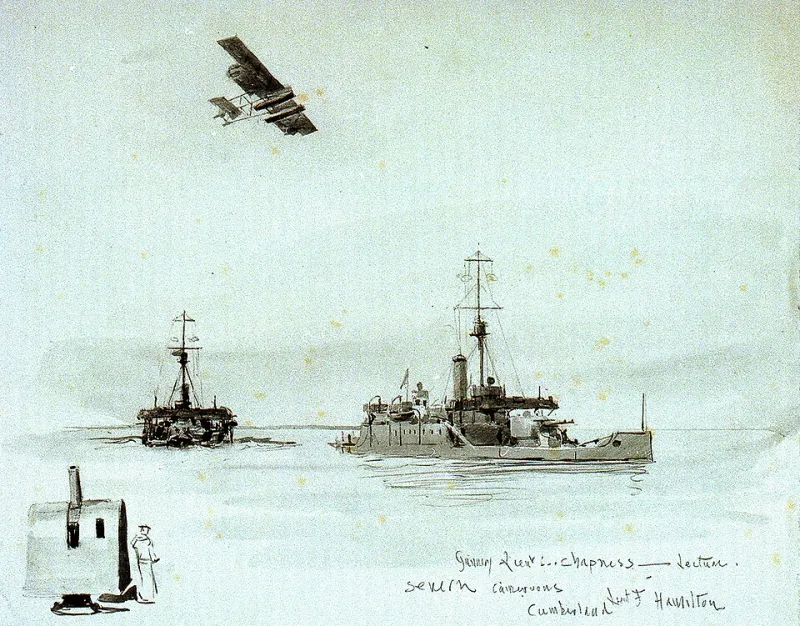
The Grand Fleet had put to sea from Scapa Flow, but it was far too late to intercept. The pre-dreadnought battleships of the 3rd Battle Squadron, stationed in the Thames approaches, were ordered south and achieved nothing beyond demonstrating that they existed. The raid exposed with uncomfortable clarity how dispersed the British battle fleet had become: the Battle Cruiser Fleet at Rosyth, the Grand Fleet in Orkney, the older battleships in the south-east, and nothing substantial between the Tyne and the Thames capable of contesting a raid.
In the weeks that followed, the Admiralty faced searching questions in Parliament and a press that had grown sceptical of assurances about command of the North Sea. The official response stressed that the enemy had achieved nothing of military value and had retired before the fleet could concentrate. Both statements were true, and both missed the point. The raid had shown that a determined German commander could appear off an English town, fire for twenty minutes, and be gone before the British could bring him to action.
What changed was less dramatic than the newspapers demanded. Coastal defences were reinforced and reorganised; light forces on the east coast were strengthened; the principle of keeping the battlecruisers concentrated and ready to the south was reaffirmed. But the underlying geometry of the North Sea — a numerically superior fleet constrained by distance, coal endurance and the need to guard a dozen possible targets — could not be altered by administrative order.
A Town That Remembers
At Lowestoft, the memory of the raid settled into the fabric of the town rather than into national narrative. Shell fragments were kept as souvenirs; damaged buildings were repaired; the dead were buried with the crowds that such funerals attracted in 1916. The centenary commemorations of 2016 brought the episode back into local view, and the 110th anniversary this April will be marked quietly — an exhibition, a wreath, a talk in a church hall — in the way that small coastal towns remember things that the wider world has moved past.
For the naval historian, the value of the raid lies in what it reveals about the limits of sea power when it is exercised defensively. The Grand Fleet was never defeated in home waters in 1916; but on one April morning it was, for all practical purposes, absent. The shells that fell on the Lowestoft promenade were the price of that absence, and a reminder that command of the sea is measured not only in battles fought but in the ordinary streets that remain unbroken behind it.