The White Hull and the Grey Zone: Hospital Ships and the Law That Did Not Hold
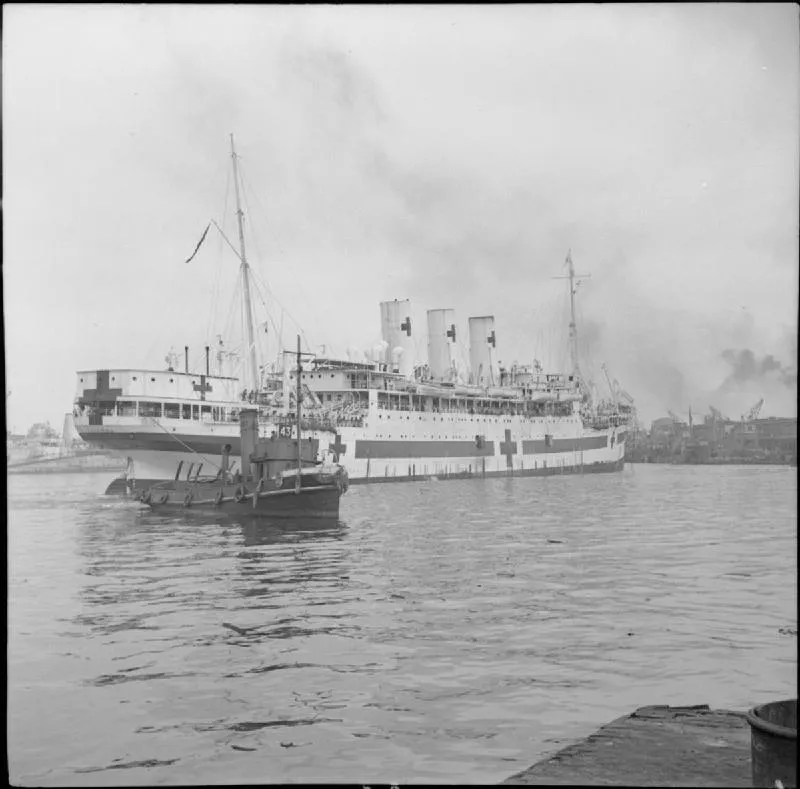
Photo: No 1 Army Film & Photographic Unit, Ely (Captain), Public domain, via Wikimedia Commons
The hospital ship was one of the war's most humane inventions and one of its most vulnerable. Under the Geneva Convention and the Hague Convention X of 1907, a vessel properly marked and notified as a hospital ship was to be respected and protected. She was not to be attacked or captured. Her white hull, green stripe and red crosses were intended to be visible from a distance and unmistakable in intent. In practice, the law at sea proved less sturdy than the paint.
Promises in White Paint
The legal framework was not an afterthought. Britain and Germany both had obligations under the conventions, and hospital ships were subject to notification and inspection regimes. The protections depended on reciprocity and on the assumption that a ship would be used only for the wounded and sick, not for military purposes. That assumption was always going to be tested in a war of blockade, submarines and suspicion. Once a belligerent believed that hospital ships were being used to carry munitions, intelligence or able-bodied troops, the white hull became a provocation rather than a safeguard.
British hospital ships operated across the Channel and into the Mediterranean, supporting the evacuation of wounded from France, Gallipoli, Salonika and the Aegean. They were part of the medical logistics of a global war, and their routes were often close to operational areas. That proximity was unavoidable. It also meant that hospital ships shared waters with mines and submarines that did not always discriminate between a transport and a floating ward.
Channel and Mediterranean Pressure
The Channel route was short, busy and dangerous. Hospital ships moved casualties from French ports to Britain while mines and U-boats threatened the same seaways. In the Mediterranean, the distances were longer and the risks more diffuse. The sinking of the Britannic in November 1916, generally attributed to a mine, showed that even a large, well-marked hospital ship could be lost. The Dover Castle was torpedoed in 1917, and the Glenart Castle in 1918, with heavy loss of life. These were not isolated accidents. They were symptoms of a wider collapse in the restraints that were supposed to protect medical shipping.
German authorities argued that British hospital ships had been used improperly, and there were cases in which the distinction between medical transport and military carriage became blurred. British opinion, understandably, focused on the attacks themselves. The result was a cycle of accusation and reprisal in which the law was invoked by both sides but trusted by neither. For the crews and medical staff, the practical effect was a sense of exposure that no amount of white paint could remove.
Mines, Torpedoes and Suspicion
Mines were a particular problem because they did not read notifications. A hospital ship following a swept channel might still be lost if the channel was imperfectly swept or if a mine had drifted. Submarines posed a different problem. A U-boat commander who suspected a hospital ship of carrying military cargo might justify an attack, and the legal machinery for protest was slow and retrospective. The fear of misuse became a self-fulfilling prophecy: suspicion encouraged attacks, attacks encouraged reprisals, and reprisals made the sea safer for no one.
Public fear in Britain added another layer. Hospital ships carried wounded men home, and their loss was felt acutely. The Admiralty and the medical services had to balance the need to move casualties quickly against the risk of routing them through dangerous waters. There was no perfect answer. To keep hospital ships away from the operational zone was to leave wounded men waiting. To send them through it was to accept that the protections of law might not hold.
The Erosion of Neutrality
The hospital ship illustrates a broader truth about the war at sea. Neutrality was not merely a legal status; it was a practical arrangement that depended on restraint, recognition and reciprocity. Once those broke down, the white hull became a grey zone. The law still mattered, but it mattered less than the operational logic of the moment. The hospital ship was supposed to be outside the fight. In reality, it was often just beyond the edge of it.
A century on, the hospital ship remains a powerful symbol of humanitarian intent. It should also be a warning. Legal protection at sea is only as strong as the willingness of belligerents to honour it and the ability of navies to operate without putting protected vessels in harm's way. The white ships of the Great War were not naïve. They were necessary. Their losses show how quickly necessity can be overwhelmed by suspicion.