Delta of Doubt: The Rufiji Campaign That Kept a Dozen Warships Guessing
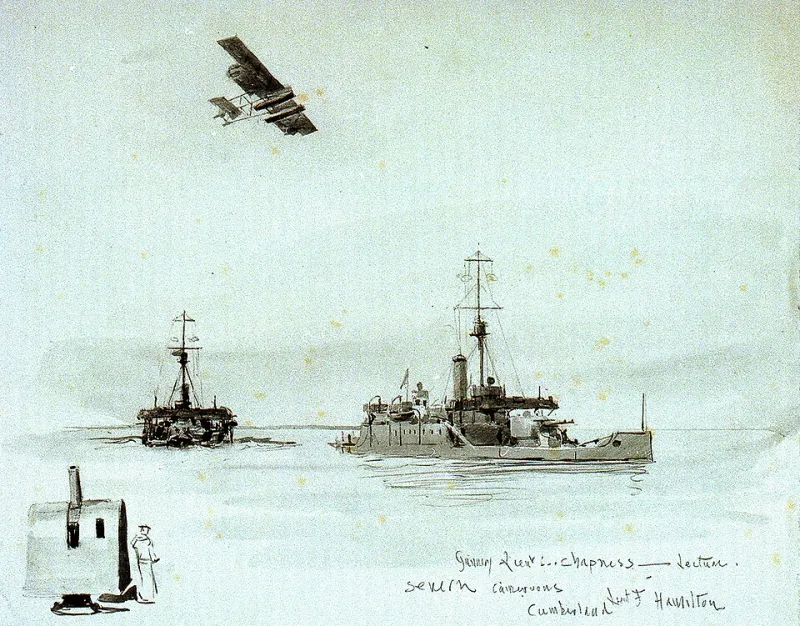
Photo: William Lionel Wyllie, Public domain, via Wikimedia Commons
When the light cruiser Königsberg slipped out of Dar es Salaam in the summer of 1914, few in the Admiralty could have predicted that this single vessel would dominate British naval planning in the western Indian Ocean for the best part of a year. Yet by the time her wreck was finally accounted for in July 1915, the ship had consumed the attention of dozens of British and Allied warships, redrawn shipping schedules across the Cape route, and prompted one of the earliest sustained experiments in combined air and sea operations.
A Commerce Raider of Modest Means
The Königsberg was no formidable adversary on paper. A 3,400-ton light cruiser armed with ten 10.5-centimetre guns, she belonged to a class designed for colonial service rather than fleet action. Her captain, Max Looff, understood the arithmetic of his position: with no German naval base east of Suez and no realistic prospect of replenishment, his ship's usefulness lay in disruption rather than destruction.
He delivered it. On 20 September 1914, off Zanzibar, the Königsberg caught the elderly protected cruiser HMS Pegasus at anchor and sank her in under half an hour. The action cost the Royal Navy 38 lives and, more significantly, its composure. A single raider had struck within sight of British territory, and the effect on colonial morale — and on London's correspondence — was immediate.
The River That Hid a Warship
The chase that followed became a study in geography as an instrument of strategy. After the Zanzibar raid, Looff took his ship into the Rufiji Delta in German East Africa, a labyrinth of channels, mangrove and mud that neutralised every advantage the Royal Navy possessed. British cruisers might command the open sea, but a warship concealed under camouflage up a tropical river was another matter entirely.
For months the hunt stalled. The blockading force — at various times including the cruisers HMS Hyacinth, Pyramus and Pioneer — could neither enter the channels nor be certain the Königsberg remained there at all. Every collier and merchantman sighted in the western Indian Ocean invited a fresh burst of speculation. Convoys on the Cape route were delayed; cruisers needed for other theatres were pinned to East African waters. It was a textbook demonstration of what modern strategists would call fleet-in-being logic, achieved not by a battle squadron but by one immobilised cruiser and a great deal of uncertainty.
Aircraft Over the Mangroves
The stalemate broke through an unlikely partnership between the sea and the sky. Early in 1915, the Admiralty dispatched Curtiss flying boats — carried out aboard the armed steamer Kinfauns Castle and later flown from improvised strips near the delta — to locate and spot for the guns that would finish the job.
The early flights were discouraging. Tropical heat sapped engine performance, and reconnaissance sorties returned with ambiguous photographs and exhausted crews. But the principle was established: aircraft would find the target, and shallow-draught monitors would engage her where cruisers could not go.
That task fell to the monitors Severn and Mersey, vessels built for the Danube and requisitioned for a river no one had imagined they would fight in. On 6 July 1915, the two monitors pushed into the delta while aircraft circled overhead, correcting fall of shot by wireless. The Königsberg's gunners replied fiercely, driving off the Mersey and damaging her foremast, but the experiment had proved itself. A second action on 11 July, again directed by spotter aircraft, reduced the German cruiser to a burning hulk. Looff ordered her scuttled; her surviving crew marched inland to fight out the rest of the war as part of von Lettow-Vorbeck's forces.
An Early Lesson in Combined Operations
The Rufiji campaign is easy to overlook between the set-piece battles of the North Sea and the Dardanelles. Yet it prefigured doctrines that would define naval warfare two decades later. Aircraft spotting for surface gunfire, monitors brought to a riverine target, and a blockade designed less to destroy than to contain — the ingredients of a combined operation were all present, if in embryo.
For the Royal Navy, the episode also carried a quieter strategic lesson. A single ship, handled with skill and sheltered by terrain, had diverted resources out of all proportion to her strength. It was a calculation German raiders would repeat elsewhere, and one British planners would remember when the next war demanded that no raider, however modest, be left unaccounted for.