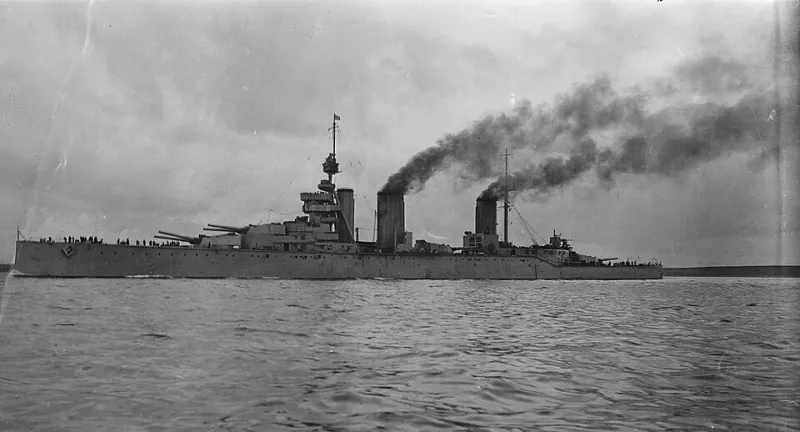
Reading the Seabed: What Jutland's Silent Fleet Tells Us a Century On
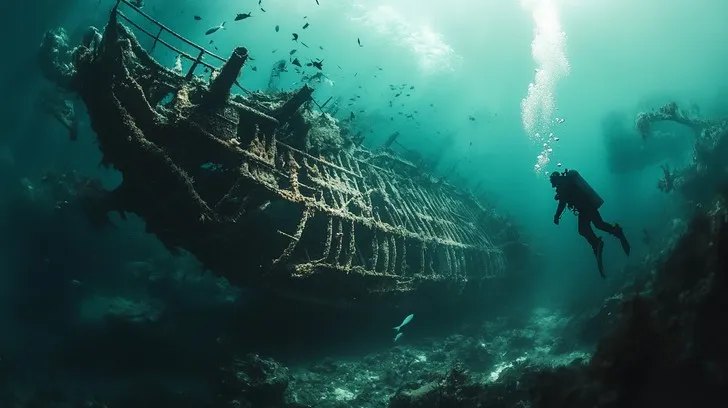
Photo: shipwreck underwater deep sea diving North Sea, via images.stockcake.com
Some 60 nautical miles off the coast of Jutland, in water that rarely rises above ten degrees Celsius, lies the densest concentration of capital shipwrecks anywhere in the world's oceans. Here, scattered across the seabed in depths of 60 to 80 metres, rest the remains of HMS Queen Mary, HMS Invincible, HMS Indefatigable, and their German adversaries — vessels that vanished in minutes on the last day of May 1916, taking more than 8,500 men with them.
For decades, these sites were charted only as hazards to fishing. That has changed. Since the centenary of the battle, a series of sonar surveys and technical diving expeditions — several led by British teams working with Danish authorities — have produced imagery of a quality the Admiralty's own casualty boards could never have hoped for.
The Evidence Written in Steel
A wreck is a document, and the Jutland hulls are unusually legible. High-resolution multibeam surveys have allowed researchers to map shell impact points on armoured belts and barbettes, effectively reconstructing the trajectories and calibres of the shells that struck. On some vessels, the pattern is stark: German 30.5cm shells penetrating British vertical armour at oblique angles with a consistency that speaks to the quality of German metallurgy and fuze design.
The most contentious testimony, however, concerns not what was struck but what burned. The near-total destruction of three British battlecruisers — while German equivalents were damaged yet largely survived — has been debated since 1916. The traditional explanation, articulated most forcefully by officers such as Admiral Beatty's gunnery staff, blamed the practice of leaving flash-tight magazine doors open and stacking cordite outside the hoists to sustain rapid fire.
The wrecks have given this debate a physical dimension. Survey work around the wreckage fields of Queen Mary and Indefatigable shows the magazines detonated with such violence that large sections of hull were displaced hundreds of metres. Yet diving inspection of surviving internal structures has complicated simple narratives: some evidence suggests propellant handling contributed, while other findings point to weaknesses in turret armour and the vulnerability of British cordite grains to flash propagation in ways German propellant was not.
A Graveyard Without Headstones
Unlike the cemeteries of Flanders, the North Sea offers no rows of markers. The wreck sites themselves are the graves of more than 6,000 British and 2,500 German sailors, and their legal status remains awkward. Under the UK's Protection of Military Remains Act 1986, several Jutland wrecks — including HMS Invincible and HMS Queen Mary — are designated protected places, rendering it an offence to disturb them without licence.
Enforcement, however, is another matter. The sites lie in Danish waters, beyond straightforward reach of British authorities, and the salvaging of scrap metal from deep wrecks has become an established, if often illicit, industry in the region. Survey teams have documented propellers removed, hull plating torn away and evidence of trawler contact on vessels that should be untouched. The practice — sometimes called 'wreck raiding' — treats the graves of sailors as a commodity in industrial bronze and steel.
British heritage bodies, alongside organisations such as the Maritime Archaeology Trust, have pressed for coordinated North Sea management, arguing that Great War wrecks deserve the same presumption of sanctity as battlefield remains on land. Denmark, for its part, has shown growing willingness to police its waters, though the sheer scale of the task is considerable.
What the Divers Found
The expeditions have yielded more than controversy. At the wreck of the German battlecruiser Lützow, scuttled en route home after the battle, divers have examined how German damage-control arrangements allowed a badly holed ship to survive conditions that destroyed her British counterparts. At Invincible — famously broken in two, her bow and stern sections standing upright on the seabed like tombstones — the midships explosion has been mapped in detail, confirming the magnitude of the magazine detonation.
Perhaps most affecting are the small traces: the boot debris, the personal effects scattered across debris fields, the shell casings still arranged as they fell. Technical divers returning from these depths consistently describe the experience in the language of the parish church rather than the museum — a place demanding quiet, not interpretation panels.
Why It Matters Now
The Jutland wrecks occupy a rare position: simultaneously an archaeological archive of the only clash of dreadnought fleets ever fought, a legal test case for the protection of maritime war graves, and a memorial to the largest number of Royal Navy personnel lost in a single action. As deep-water salvage technology becomes cheaper and metal prices remain attractive, the window in which these sites can be studied intact is narrowing.
The lesson of the seabed surveys is double-edged. The wrecks have answered questions that archives could not — and they have done so at the cost of reminding us that history's most important documents sometimes lie 70 metres down, in the dark, holding the men who wrote them.