Forty Percent of the Fleet's Lifeline: The Shipping Crisis That Forced the Admiralty's Hand
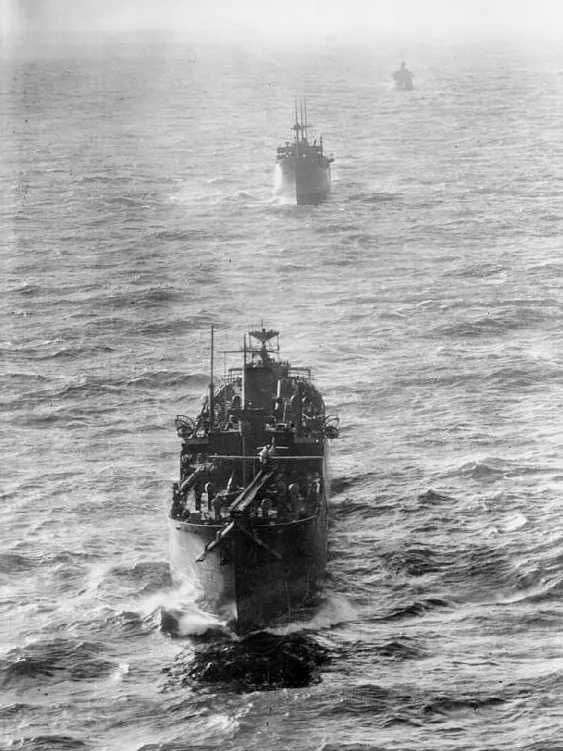
Photo: Royal Air Force official photographer, Public domain, via Wikimedia Commons
A Nation Measuring Its Bread
In the winter of 1916–17, the war at sea shifted from the dramatic fleet engagements of Jutland to something quieter and altogether more dangerous to Britain's survival. On 1 February 1917, Germany resumed unrestricted submarine warfare, and within weeks the effect on British merchant shipping was catastrophic. Tonnage losses climbed from roughly 300,000 gross tons per month in early 1917 to more than 860,000 tons in April — a rate at which, Admiralty planners privately conceded, Britain could not sustain the war beyond the autumn.
The statistics were not merely naval bookkeeping. They were measured in bakeries across London, Manchester and Glasgow. By late April, the Ministry of Food — formally established that same year — was confronting the prospect of genuine scarcity. Wheat reserves fell to approximately six weeks' supply. Rationing, though not yet universal, loomed over every household.
Why the Admiralty Resisted
The remarkable feature of the crisis is not that convoy was eventually adopted, but that the Admiralty fought against it for so long. The Board of Trade, the Ministry of Shipping under Sir Joseph Maclay, and increasingly the War Cabinet all pressed for escorted sailings. The Naval Staff, however, advanced a series of objections that seemed plausible on paper.
Convoys, it was argued, would merely concentrate targets for the U-boats. Ports lacked the capacity to receive great fleets of merchantmen simultaneously. There were insufficient escort vessels, insufficient trained signalling personnel, and insufficient harbour facilities at the western approaches. Above all, there was a doctrine: the Admiralty's preferred remedies remained hunting patrols, Q-ships, and minefields — offensive measures consistent with the Royal Navy's traditions.
The Q-ship campaign, the subject of considerable romantic attention then and since, achieved modest results against a submarine enemy that preferred torpedoes at range to surface gun duels. Patrolled areas simply pushed U-boats elsewhere. The sea was too large for the hunter to find the hunted.
The Turn to Convoy
The intellectual breakthrough came less from within the Admiralty than from outside it. Commander Reginald Henderson, working with the Shipping Controlling Department, produced an analysis demonstrating that escorted sailings were feasible with the destroyers available, provided convoys were routed around the known danger zones. His memorandum of February 1917 dismantled the escort-shortage argument with arithmetic rather than sentiment.
The first experimental convoy — a dozen ships from Gibraltar, escorted by HMS Verona and HMS Pelican — sailed on 10 May 1917 and arrived without loss. The results across the following months were decisive. Ships sailing in convoy suffered losses a fraction of those sailing independently. By the autumn, the transatlantic and Gibraltar routes were largely organised under escort, and monthly sinkings began a decline from which they never fully recovered.
What the Records Reveal
Admiralty papers held at The National Archives in Kew document the internal resistance in unusual detail, including minutes in which senior officers predicted failure even as the first convoys succeeded. Home front sources — diaries, board of trade returns, the papers of the Ministry of Food — complement the picture, showing a public increasingly aware that the decisive battle of the war was being fought not in the North Sea but along the approaches to the Channel and the Western Isles.
The convoy revolution carried a deeper lesson that reshaped naval strategy for the remainder of the conflict and beyond: sea power in a total war is measured less by battleship tonnage than by the protection of the maritime arteries of trade. Jellicoe's Grand Fleet had held command of the surface; it was the humble escorted freighter that held the war together.
By November 1918, Britain had not been starved into submission. The U-boats had sunk more than 12 million tons of shipping, yet the lifelines held. The winter of 1917 remains the closest the United Kingdom came to defeat at sea without a single decisive engagement — and the clearest demonstration that in maritime war, administration can matter as much as armament.
